
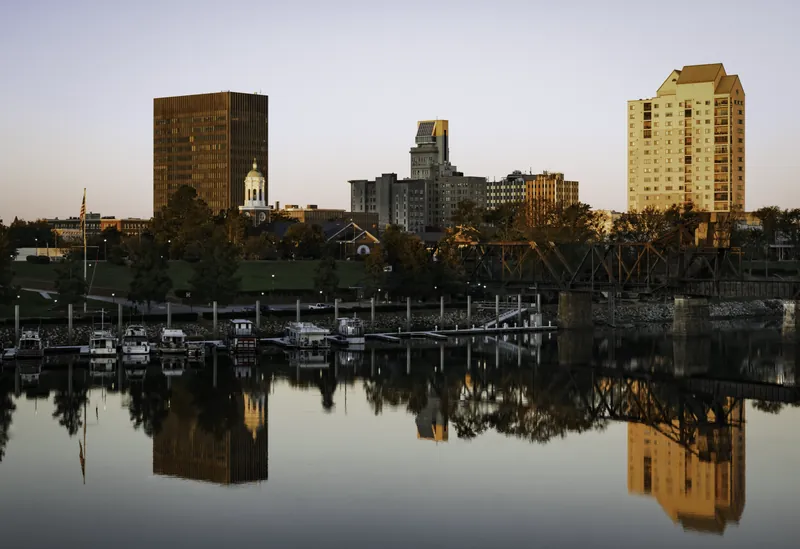
Fast Facts
- Population
- ~202,000 (2020 census)
- Typical visiting season
- Spring or fall — never Masters week
- One Unusual Stat
- Georgia’s first National Heritage Area (1996)
- Miles from Atlanta
- ~150 mi · ~2.5 hrs
What to Know Before You Arrive
Augusta started in 1736 as a fortified trading post that James Oglethorpe planted at the fall line of the Savannah River, the point where boats coming upriver had to stop. He named it for Princess Augusta of Saxe-Gotha, mother of the future King George III — a woman who never once saw the place. The town spent a decade as Georgia’s state capital in the 1780s and ratified the U.S. Constitution here on January 2, 1788. Locals call it the Garden City, and in 1996 the city and county governments merged into one, so “Augusta” today technically means all of Richmond County.
Augusta National Golf Club, home of the Masters, sits on the west side of town, and almost none of it works the way visitors assume. Tournament and practice-round tickets are never sold at a gate — every one is distributed in advance through an online application that Augusta National runs itself, and it accepts roughly 0.5% of applicants. The one path that used to skip the lottery, an all-access “patron” series badge with its own waiting list, has been closed to new names since 2000, and the club has never said whether or when it will reopen. A badge covering all four tournament days has recently been priced near $525*, when one can be had at all. None of this is a trick Augusta plays on visitors — it is simply how the world’s most private golf club has always worked. Come see the city; the golf tickets are a different, much longer errand.
Augusta’s other global export is James Brown, who arrived here at about four or five years old and later danced for change to entertain soldiers from Camp Gordon near a canal bridge by his aunt’s home; in 1993 a section of 9th Street was renamed James Brown Boulevard in his honor. He won a talent contest at the long-gone Lenox Theater in 1944, and years after “Please, Please, Please” made him famous, he bought the local radio station where he had once shined shoes. His downtown statue came down from Broad Street in July 2025 and is stored at the Augusta Museum of History while the city rebuilds the block around it into James Brown Linear Park, where Augusta-Richmond County has said it will return as the centerpiece. We were unable to confirm whether the statue has been reinstalled. The Augusta Museum of History, open year-round, holds the largest permanent collection of his stage costumes and memorabilia anywhere.
*Fees subject to change, please check en.wikipedia.org for updated information.
The Road Trip Stop
The Augusta Canal is the reason this city sits exactly where it does, and 180 years later it is still doing useful work. Dug by hand starting in 1845 to power cotton mills at the Savannah River’s fall line, it remains a working source of Augusta’s drinking water today and, since 1996, is the first National Heritage Area ever designated in Georgia. The strangest chapter belongs to the Civil War: a gunpowder factory built along the canal grew into the Confederacy’s largest and, for a time, the second-largest in the world, before the war ended. Its 150-foot chimney still stands at a working mill a short drive from the Discovery Center.
Budget the time
- Start at the Discovery Center at Enterprise Mill, 1450 Greene Street, open Tuesday–Saturday. The exhibits explain the mills and the powder works before you ever get on the water.
- Book the boat tour ahead of time. Electric tour boats run Tuesday–Saturday; tickets run $14* for adults and $12* for seniors, military and students, and the schedule shifts with the season, so call ahead.
- The towpath is open to walk or bike if you’d rather skip the boat. The gravel path runs roughly seven miles along the canal and is free and open every day.
- Pair it with the Powderworks chimney at Sibley Mill, a few minutes downstream, to see the one Civil War–era structure on the canal that never came down.
*Fees subject to change, please check augustacanal.com for updated information.
Neighborhoods
Broad Street & Downtown
Augusta’s main street runs eight lanes wide with a planted median, wide enough that the city closes half of it for the Saturday farmers market without stopping traffic. Storefronts, Sacred Heart’s twin spires, and the future site of a James Brown memorial park all sit within a few blocks of each other.
Summerville (the Hill)
The high ground above downtown, built out as Augusta’s streetcar suburb; Augusta University’s original campus occupies a former U.S. Army arsenal here dating to 1816, and the neighborhood sits closer to Augusta National than any other residential area in the city.
Harrisburg
A historic district beside the Augusta Canal, listed on the National Register of Historic Places as the Harrisburg–West End Historic District; the National Park Service records bungalow/Craftsman and Queen Anne among its architectural styles. We were unable to confirm which canal mills the neighborhood grew up around or whether its early-1900s Craftsman bungalows are being restored.
North Augusta, SC & Hammond’s Ferry
Technically a different state, reached from Augusta on foot by the 5th Street pedestrian bridge, renamed Freedom Bridge, over the Savannah River. Riverside Village at Hammond’s Ferry, home to the GreenJackets’ SRP Park, overlooks the river and the city of Augusta.
The Food Stop
Sconyers Bar-B-Que started in 1956 as a roadside stand run by Claude and Adeline Sconyers and has stayed family-run ever since; People magazine named it one of the ten best barbecue restaurants in the country in 1989, and its pit-cooked pork once traveled to the White House lawn for President Jimmy Carter.
The Boll Weevil Cafe & Sweetery fills a cotton warehouse built before 1850, a few blocks from the Morris Museum of Art on the Riverwalk. The restaurant opened in 1990, and the dessert case — more than thirty options deep — is the real reason people drive across town for lunch.
One brewery within 10 miles of Augusta, though our source does not record a room you can sit in.
See all 1
- Savannah River Brewing Company813 5th St, Augustaproduction site*
*Check before you go. This list says what the source records as open and where it is — nothing more. Opening hours, whether a kitchen is serving, and whether anywhere suits your family are not in this data and change without notice. A production site may have no public room at all. Please confirm with the venue.
Brewpub locations from Open Brewery DB (MIT)
The Home Teams
Augusta GreenJackets
Carolina League (Single-A, Atlanta Braves)Named for the green jacket the Masters winner puts on every April, the franchise has played in or right across the river from Augusta since 1988, first as the Augusta Pirates. SRP Park opened in 2018 and seats 4,782; once a season the team plays as “the Pimento Cheese,” a nod to the Masters’ famous concession-stand sandwich.
Augusta University Jaguars (Golf)
NCAA Division I, West Coast Conference (golf only)Most Augusta University teams play Division II in the Peach Belt Conference, but the golf programs compete in Division I as West Coast Conference affiliates. The men won back-to-back national championships in 2010 and 2011, the first repeat champion since Houston in the mid-1980s, and alumnus Patrick Reed went on to win the Masters himself in 2018.
No NFL, MLB, NBA, NHL or MLS team calls Augusta home; the nearest is roughly 150 miles away in Atlanta. A new downtown arena is due to open in 2027 on the site of the old James Brown Arena, with the ECHL’s Augusta Lynx as the first tenant — it isn’t open yet, so don’t build a trip around it.
Day Trips
| Destination | Time | Distance | How we got it |
|---|---|---|---|
| Aiken, SC | 34 min | 21 mi | routed |
| Twenty minutes into South Carolina and a different world: a Gilded Age “Winter Colony” that families like the Hitchcocks and Whitneys built around horse racing, with the Aiken Thoroughbred Racing Hall of Fame and dirt training tracks still running through downtown. | |||
| Edgefield, SC | 41 min | 27 mi | routed |
| Home of the alkaline-glazed stoneware known as Edgefield pottery, developed in the early 1800s, made famous by David Drake, an enslaved potter who signed and dated his massive storage jars at a time when teaching an enslaved person to write was against the law. | |||
| Thomson, GA & Clarks Hill Lake | 45 min | 35 mi | routed |
| Thomson is the birthplace of blues musician Blind Willie McTell, and Clarks Hill Lake (Lake Strom Thurmond) is a 71,100-acre reservoir on the Georgia–South Carolina border, with its dam on the Savannah River 22 miles above Augusta, according to the U.S. Army Corps of Engineers. The Corps says most of its day use areas have swim beaches, though its March 2026 release said the full reopening of several areas was still pending repairs. | |||
| North Augusta & Hammond’s Ferry | 7 min | 3 mi | routed |
| Barely a day trip — more a walk across the river — but Riverside Village and SRP Park sit on the South Carolina bank with their own restaurants and, most summer evenings, a minor-league ballgame. | |||
Routed figures are computed over map data at free-flowing speeds, between map points rather than street addresses, so a real drive runs longer.
Distances routed by OSRM and places geocoded by Nominatim, over map data © OpenStreetMap contributors (ODbL)
Worth a Weekend
10 more Highway Heads places lie within about 180 miles of Augusta in a straight line — far enough that most are a night away rather than an afternoon.
- ColumbiaSouth Carolinaabout 65 mi
- AthensGeorgiaabout 85 mi
- Hilton HeadSouth Carolinaabout 110 mi
- SavannahGeorgiaabout 110 mi
- CharlestonSouth Carolinaabout 130 mi
- AtlantaGeorgiaabout 140 mi
- CharlotteNorth Carolinaabout 140 mi
- AshevilleNorth Carolinaabout 150 mi
- Great Smoky MountainsTennesseeabout 180 mi
- Myrtle BeachSouth Carolinaabout 180 mi
Practical Road Trip Info
Budget one full day for downtown Augusta: the canal, the Riverwalk, the Museum of History and a barbecue lunch fit comfortably between breakfast and dinner. Add a second day if you’re folding in Aiken, Edgefield or Clarks Hill Lake.
Avoid planning a visit around Masters week in early April unless you already have a way in. Lodging gets scarce and very expensive that week — one estimate put short-term rental bookings across Augusta at $8.5 million for the week alone — and plenty of locals rent out their own houses and leave town rather than fight the traffic. Outside that week, Augusta is calm and easy on the wallet.
Summers are hot and heavy with humidity; Augusta sits in the humid subtropical belt and rarely sees real snow. Spring and fall are far more comfortable for walking the Riverwalk or the canal towpath.
Downtown parking rules were not confirmed — we were unable to confirm the current meter hours or rates, and posted signs on each block are the authority. The Augusta Museum of History is at 560 Reynolds Street and the Augusta Canal Discovery Center at 1450 Greene Street; we were unable to confirm the walking distance between them and the Riverwalk.
5 public campgrounds within 25 miles of Augusta, all bookable ahead. Public campgrounds run by federal agencies. State-park and private campgrounds are not included.
The Local Debate
Family-Friendly
Phinizy Swamp boardwalks
Flat, easy trails and a real chance of spotting an alligator or a river otter from a boardwalk — a hit with kids who get bored on an ordinary nature walk.
Augusta Canal boat tour
A slow, guided ride that turns 180 years of mill history into something children will actually sit still for.
Augusta Museum of History
The James Brown gallery and hands-on local-history exhibits give kids something to touch and ask about, not just glass cases to walk past.
A GreenJackets game at SRP Park
Minor-league baseball with cheap tickets and enough between-innings noise to hold a child’s attention for nine innings.
Plan Your Visit
Augusta Canal Discovery Center
- Address
- 1450 Greene St, Suite 400, Augusta, GA 30901
- Hours
- Discovery Center: Tuesday–Saturday, 9:30am–3pm; boat tours Tuesday–Saturday, call ahead for times
- Price
- $14 adults, $12 seniors/military/students for the boat tour; Discovery Center exhibits included*
- Link
- augustacanal.com
*Fees subject to change, please check augustacanal.com for updated information.
We checked reservations, fees, closures, opening hours, seasonal opening and contact details on 2026-09-21. These change without notice — confirm with en.wikipedia.org, augustamuseum.org, augustacanal.com, theaugustapress.com, exploregeorgia.org, phinizycenter.org and sas.usace.army.mil the week you travel.
Sources — 37 claims, 36 checked against the source on 2026-09-21
| Claim | Source | Status |
|---|---|---|
| Founded 1736 by James Oglethorpe; named for Princess Augusta of Saxe-Gotha; capital of Georgia 1785–1795; ratified the U.S. Constitution Jan 2, 1788; nickname “Garden City”; fall line of the Savannah River; consolidated city-county government 1996; population ~202,071 (2020); ~150 miles from Atlanta | Augusta, Georgia — Wikipedia | Checked |
| Augusta Canal completed 1845; first National Heritage Area in Georgia (1996); National Historic Landmark 1977; Discovery Center at Enterprise Mill opened 2003; ~7-mile towpath; still a drinking-water source; Sherman’s 1864 march bypassed Augusta | Augusta Canal — Wikipedia | Checked |
| Confederate Powderworks built from 1861, operating by 1862; made about 2.75 million pounds of gunpowder; ranked the second-largest gunpowder factory in the world at the time; only its 150-foot chimney survives, at Sibley Mill | Confederate Powderworks — Wikipedia | Checked |
| Augusta National founded 1932 by Bobby Jones and Clifford Roberts on the former Fruitland Nurseries; course designed by Jones and Alister MacKenzie; Amen Corner named by Herbert Warren Wind in 1958; Eisenhower Tree removed 2014; first Black member 1990, first women members 2012 | Augusta National Golf Club — Wikipedia | Checked |
| Masters first played 1934; green jacket tradition since 1949; all tickets sold in advance, none at the gate; patron waiting list opened 1972, closed 1978, reopened 2000, closed again; Georgia law bars ticket resale within 2,700 feet of the club; a four-day badge recently priced near $525 | Masters Tournament — Wikipedia | Checked monitored · 2026-09-21 |
| Public lottery for practice-round and daily tournament tickets accepts roughly 0.5% of applicants; the all-access patron waiting list has been closed since 2000 with no reopening announced | Masters Badges: What They Are and How to Get Access — The Blend Group | Checked |
| James Brown moved to Augusta around age four or five; won a talent show at the Lenox Theater in 1944; performed buck dances for change to entertain Camp Gordon troops near a canal bridge by his aunt's home; met Bobby Byrd after release from juvenile detention, forming the Famous Flames; bought Augusta radio station WRDW in the late 1960s; a section of 9th Street was dedicated as James Brown Boulevard in November 1993 | James Brown — Wikipedia | Checked |
| Morehouse College founded 1867 in Augusta as the Augusta Institute at Springfield Baptist Church; moved to Atlanta in 1879; renamed Morehouse College in 1913 | Morehouse College — Wikipedia | Checked |
| Springfield Baptist Church congregation established 1787; among the oldest Black congregations in the country, a title several churches contend for; 1801 building is the oldest church still standing in Augusta; listed on the National Register of Historic Places in 1982 | Springfield Baptist Church (Augusta, Georgia) — Wikipedia | Checked |
| Augusta Museum of History admission $7 adults, $6 seniors, $5 ages 6–18, free for members and ages 5 and under; open Thursday–Saturday 10am–5pm and Sunday 1–5pm | Augusta Museum of History — Visit | Checked monitored · 2026-09-21 |
| Augusta Museum of History holds the largest permanent collection of James Brown memorabilia anywhere, including 1960s stage costumes and a 1950s stage crown; notes his Grammy wins, 1986 Rock and Roll Hall of Fame induction, and 2003 Kennedy Center Honors | James Brown Exhibit — Augusta Museum of History | Checked |
| Boat tours depart from the Discovery Center at Enterprise Mill, 1450 Greene Street; tickets $14 for adults and $12 for seniors 60+, military or students; Discovery Center open Tuesday–Saturday 9:30am–3pm; boat tours run Tuesday–Saturday, call ahead for availability | Augusta Canal Authority — official site | Checked monitored · 2026-09-21 |
| Morris Museum of Art founded 1985 by William S. Morris III as the first museum dedicated to art of the American South; opened to the public September 26, 1992; holds more than 5,000 works; sits on the Riverwalk | Morris Museum of Art — Wikipedia | Checked |
| Augusta University formed 2013 from the merger of Augusta State University and Georgia Health Sciences University; medical roots trace to an 1828 charter; Summerville campus occupies a former U.S. Army arsenal established in 1816 | Augusta University — Wikipedia | Checked |
| Augusta University men’s and women’s golf compete in Division I as West Coast Conference affiliates; the men won back-to-back NCAA Division I titles in 2010 and 2011, the first repeat champion since Houston in 1984–85; alumnus Patrick Reed won the 2018 Masters | Augusta Jaguars — Wikipedia | Checked |
| Augusta GreenJackets play in the Carolina League as a Single-A Atlanta Braves affiliate; franchise dates to 1988 as the Augusta Pirates; SRP Park in North Augusta, SC seats 4,782, opened 2018; named for the Masters winner’s green jacket; plays once a year as “the Pimento Cheese&rdquo | Augusta GreenJackets — Wikipedia | Checked |
| James Brown Arena closed May 31, 2024; New Augusta Arena rising on the same site, expected to open spring 2027 with the ECHL’s Augusta Lynx as primary tenant | New Augusta Arena — Wikipedia | Checked |
| Sconyers Bar-B-Que opened 1956 by Claude and Adeline Sconyers as a roadside stand; named a top-ten U.S. barbecue restaurant by People magazine in 1989; catered for President Jimmy Carter at the White House in 1980 | Sconyers Bar-B-Que — Wikipedia | Checked |
| Boll Weevil Cafe & Sweetery building dates to before 1850 as a cotton warehouse; opened as a restaurant in 1990 by third-generation owner George Harrison | The Boll Weevil Cafe & Sweetery — official site | Checked |
| Blind Willie McTell born near Thomson, Georgia; recorded more than 120 titles across fourteen sessions; “Statesboro Blues” entered the Grammy Hall of Fame in 2017; buried near his birthplace at Jones Grove Church | Blind Willie McTell — Wikipedia | Checked |
| Aiken, SC is about 20 miles from Augusta; Winter Colony era began with Thomas Hitchcock Sr. and William C. Whitney; Aiken Steeplechase Association founded 1930; Thoroughbred Racing Hall of Fame and Museum established 1977 | Aiken, South Carolina — Wikipedia | Checked |
| Edgefield, SC is roughly 26 miles from Augusta; alkaline-glazed stoneware pottery tradition developed by Dr. Abner Landrum in the early 1800s; enslaved potter David Drake signed and dated his large stoneware jars | Edgefield, South Carolina — Wikipedia | Checked |
| Masters week 2025 short-term rental bookings across Augusta topped $8.5 million, an 11% increase over 2024; average nightly rate hit $514 versus a typical $200; Augusta-area schools schedule spring break around the tournament | Fore Rent: Augusta’s $20M Masters Short-Term Home Market — Front Office Sports | Checked |
| Still unconfirmed on an acceptable source: whether the James Brown statue has been reinstalled on Broad Street; which canal mills the Harrisburg neighborhood grew up around and whether its early-1900s Craftsman bungalows are being restored; current downtown Augusta parking meter hours and rates; walking distances between the Riverwalk, the Museum of History and the Canal Discovery Center; the driving distance from Thomson to Clarks Hill Lake | No source accepted yet | Not confirmed |
| James Brown statue moved from Broad Street starting July 17, 2025 and stored at the Augusta Museum of History during James Brown Linear Park construction, to return as the park's centerpiece (per an Augusta-Richmond County press release); current reinstall status not confirmed | James Brown Statue to be temporarily relocated — The Augusta Press | Checked monitored · 2026-10-13 |
| Harrisburg–West End Historic District, Augusta: National Register of Historic Places district (NRIS 90000802, published 1990), roughly bounded by 15th St., Walton Way, Heard Ave., Milledge Rd., and the Augusta Canal; architectural styles listed include bungalow/Craftsman and Queen Anne | Harrisburg–West End Historic District — National Park Service NPGallery | Checked |
| 5th Street bridge over the Savannah River in Augusta converted to a pedestrian crossing (a $9 million project by Georgia DOT); bridge between Augusta and North Augusta opened September 24, 2022; known as Freedom Bridge | Historic 5th Street Pedestrian Bridge Rehabilitation Project — America’s Transportation Awards | Checked |
| Freedom Bridge (the former 5th Street bridge) opened as a pedestrian bridge between Augusta and North Augusta on Sept. 24 (2022) | Fifth Street pedestrian bridge now open connecting Augusta, North Augusta — Post and Courier | Checked |
| SRP Park is part of Riverside Village at Hammond's Ferry, which overlooks the Savannah River and the city of Augusta | SRP Park — Wikipedia | Checked |
| Sacred Heart Cultural Center: first bricks laid 1897; first service December 2, 1900; twin spires, fifteen styles of brickwork, ninety-four stained glass windows; last Mass July 3, 1971; rescued by the Peter S. Knox family and reopened in 1987 as a cultural center | About Us — Sacred Heart Cultural Center | Checked |
| Sacred Heart church closed in 1971 due to escalating maintenance costs and a declining neighborhood population; listed on the National Register of Historic Places in 1972 | Sacred Heart Cultural Center — Wikipedia | Checked |
| Phinizy Swamp Nature Park: 1,150 acres (state tourism listing; Wikipedia gives 1,100), free and open to the public 365 days a year from dawn until dusk; wildlife includes great blue heron, river otter and alligator | Phinizy Swamp Nature Park — Explore Georgia | Checked monitored · 2026-10-13 |
| Phinizy Swamp Nature Park is free and open to the public 365 days a year, roughly dawn to dusk (7AM-7PM October through March, 7AM-8PM April through September per the operator); two short wooden boardwalks and a dirt Pond Trail among the key features | Location & Contact; Trails & Features — Phinizy Center for Water Sciences | Checked monitored · 2026-10-13 |
| Phinizy Swamp Nature Park is a 1,100-acre nature park in Augusta, Georgia | Phinizy Swamp Nature Park — Wikipedia | Checked |
| J. Strom Thurmond (Clarks Hill) Lake: 71,100 acres at full pool; dam on the Savannah River 22 miles above Augusta; Corps day use areas, most with swim beaches; full reopening of some areas pending repairs as of March 27, 2026 | J. Strom Thurmond Dam and Lake — U.S. Army Corps of Engineers, Savannah District | Checked monitored · 2026-10-13 |
| Lake Strom Thurmond (Clarks Hill Lake in Georgia) is a reservoir on the Georgia–South Carolina border in the Savannah River basin | Lake Thurmond — Wikipedia | Checked |
| Augusta Museum of History is at 560 Reynolds Street, Augusta, GA 30901 | Visit — Augusta Museum of History | Checked monitored · 2026-10-13 |
Road Trippin’ with the Harts
The Highway Heads books turn the miles between stops into a game the whole car can play.
See the booksLive Conditions
Wildlife Spotted Nearby
Nearest Airports
Straight-line distance from Augusta, not drive time.
- Daniel Field (DNL) — 4 miles
- Augusta Regional At Bush Field (AGS) — 7 miles
- Columbia Metropolitan (CAE) — 59 miles
Also in
A stop on this page turns up in other Highway Heads collections.
Explore the Full Road Trip
Return to the Highway Heads map and discover the next family-ready stop.
Explore the Map